


By Robert Kibet
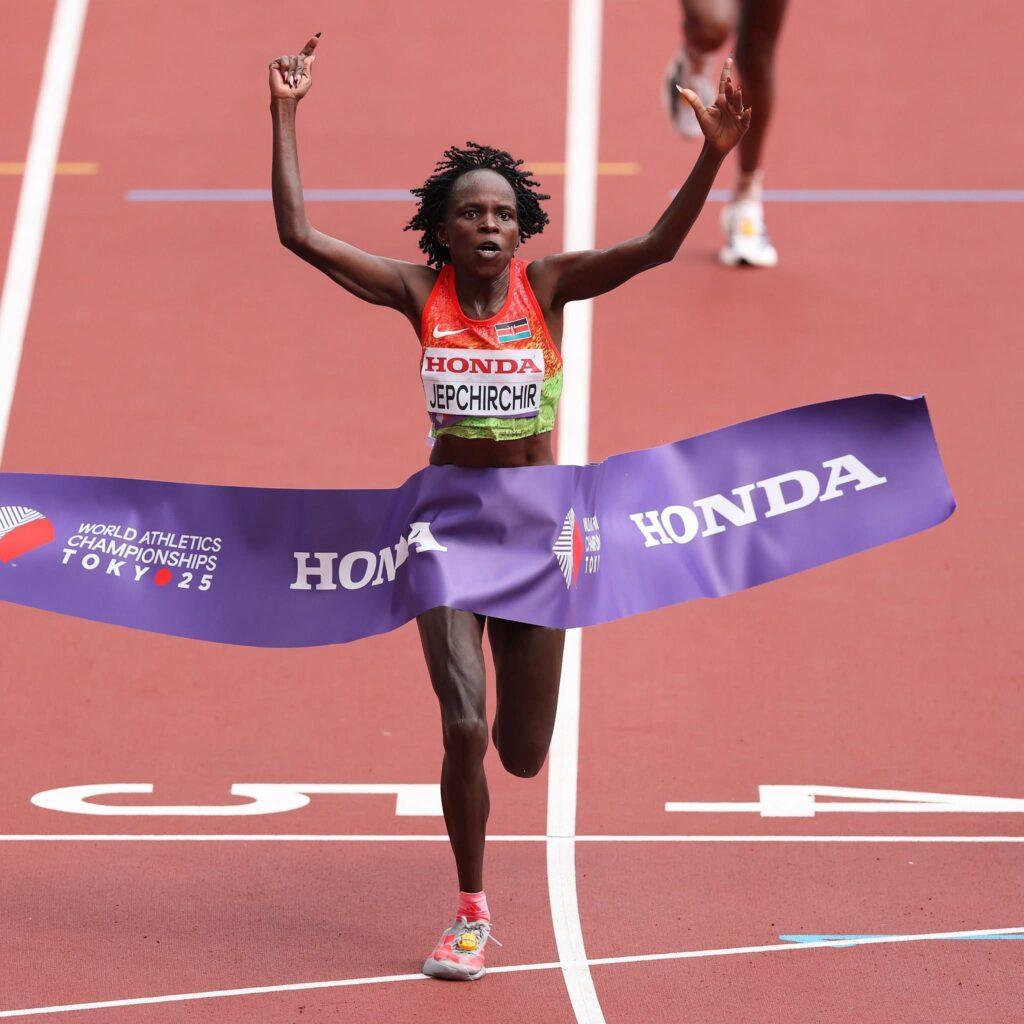
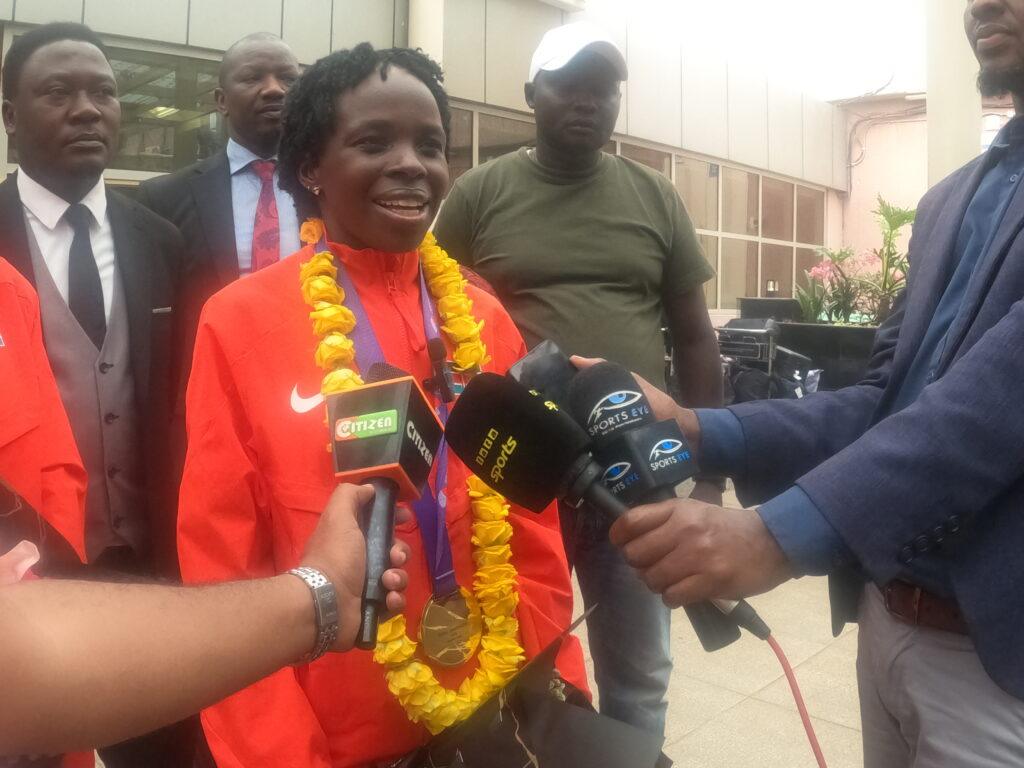
When Peres Jepchirchir, Kenya’s newly crowned World Athletics Championships marathon gold
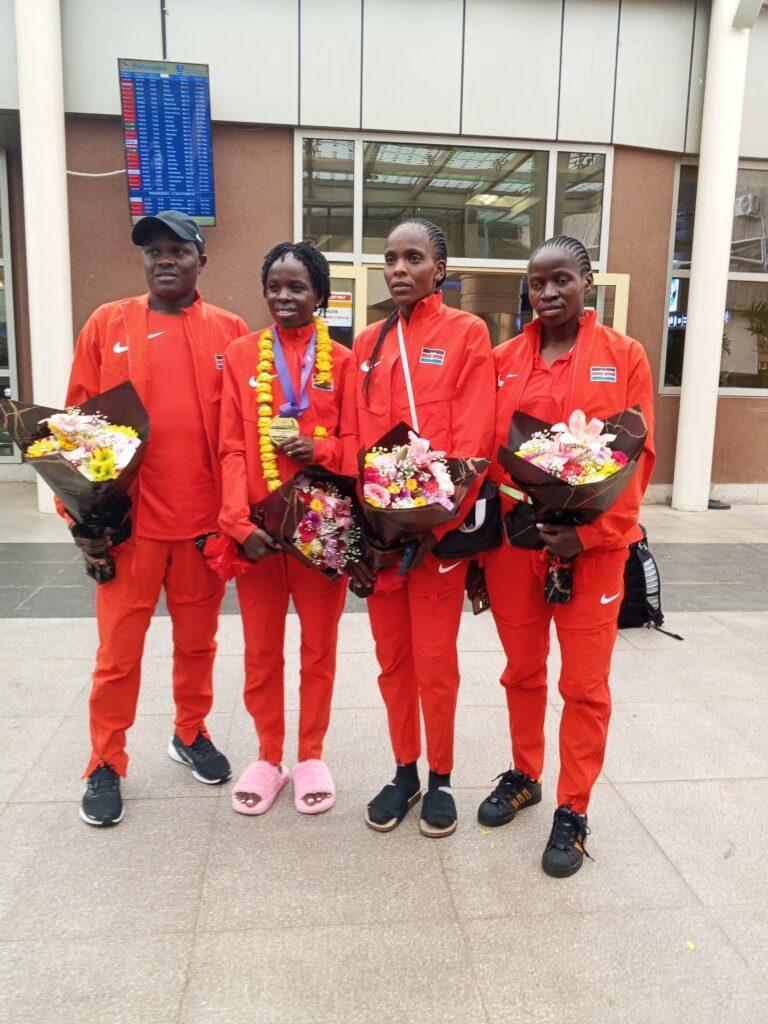
medalist, emerged from the arrivals gate at Jomo Kenyatta International Airport (JKIA) on
Tuesday night, a roar swept through the crowd.
Traditional dancers stomped to rhythmic beats, fans erupted in cheers, and officials lined up to
embrace the marathon queen. For a moment, the airport’s arrival wing turned into a standstill.
This was no ordinary reception.
Jepchirchir, alongside compatriots Jackline Cherono, Magdalene Masai, and Janeth Ngetich, the
first batch of Kenyan athletes returning from Tokyo, were welcomed home as a symbol of
resilience, pride, and enduring global dominance in the marathon.
“We are very happy and delighted to welcome them. We assure our athletes and sportsmen,
and women of full government support for making us proud as a country. This is just to congratulate them, especially our gold medalists,” said Jonah Towett, Senior Assistant Secretary in the State Department for Sports, underscoring the government’s recognition of the athletes’
achievement.
For Jepchirchir, this victory carried personal weight. After battling injuries in recent years, she
proved once again why she remains one of the greatest marathoners of her generation. The
win wasn’t just a medal. It was a statement of resilience and a reaffirmation of Kenya’s mastery
of the marathon.
Marathon Legacy of Kenyan Women
Peres Jepchirchir’s gold medal adds another chapter to a story that’s decades in the making.
In the 1990s, Tegla Loroupe broke barriers, becoming the first African woman to win a major
international marathon.
Then came Catherine “Catherine the Great” Ndereba who secured multiple world titles and
Olympic silver medals. Edna Kiplagat and Mary Keitany extended the tradition, conquering the World Marathon Majors and cementing Kenya as the global powerhouse in women’s marathon running.
Now, Jepchirchir joins that pantheon of champions.
Her Olympic and World Championship medals, combined with major marathon wins in New
York, Boston, and London, make her the defining marathoner of her era. Elizabeth Keitany, speaking on behalf of Athletics Kenya officials present at the reception, emphasized the continuity of success: “This win is a true reflection of the hard work put in by our athletes. As Athletics Kenya, we stand with them and remain focused on ensuring Kenya continues to dominate globally.”
And as Keitany, who serves as Athletics Kenya’s safeguarding secretary, pointed out,
Jepchirchir’s gold is not an isolated achievement: “Peres has made the country proud, and as a
federation, we are confident that in the remaining races in Tokyo, our athletes will bring home
more medals. This shows that Kenyan women are not just participating, but leading the world
in marathon running.”
Inside the Tokyo Race
It wasn’t easy. Tokyo’s heat and humidity turned the marathon into a test of survival as much
as speed. For Jepchirchir, the race was a tactical masterpiece. She stayed patient, kept her
rhythm, and struck at the decisive moment against Ethiopia’s strongest contenders.
Joseph Kahugu, Kenya’s long-distance coach, highlighted how Jepchirchir’s discipline paid off.
“Peres was very strong from the beginning to the end. She believed in herself and executed her
race perfectly despite the fierce challenge from Ethiopia. That determination is what sets our
athletes apart,” he said.
But Kahugu was candid about the challenges in preparation. “Back home, we didn’t get
conditions similar to Tokyo’s heat. When we arrived, we had to adjust by training to the hottest
part of the day. That helped, but with more structured scientific backing, our athletes can be
even better prepared.” His words underline a growing truth: Kenya’s natural strengths are unmatched, but science is the next frontier.
Why Kenya Produces Champions
The Rift Valley remains the cradle of champions. In towns like Iten, Eldoret, Kapsabet, and
Kericho, oxygen-thin air builds endurance, while rolling hills harden legs and lungs. Running is
woven into daily life; children jog to school, young athletes train in groups, and farms provide
the labor that builds strength long before formal training begins.
This environment produces not just physical capacity, but a mindset of resilience. For many,
running is a path to education, livelihood, and global opportunity. That hunger, combined with
tradition and altitude, continues to propel Kenyans to the top.
Jepchirchir embodies this spirit. Her victory in Tokyo was not just hers alone—it was a victory
for the training groups in the Rift Valley, for the young girls chasing dreams on dirt roads, and
for a nation that sees itself reflected in its runners.
The Role of Science in the Next Era
Yet, the marathon is evolving. Advances in sports science, ranging from heat chambers and
hydration analytics to wearable technology and data-driven recovery programs, are redefining
performance.
Carbon-plated shoes have already reshaped marathon times, while tailored nutrition and
biomechanical analysis are helping athletes find marginal gains. For Kenya, the challenge is to integrate these innovations without losing the grit, community,and natural advantages that make its runners unique.
Kahugu’s reflections point toward a solution: structured acclimatization programs, investment
in physiology labs, and collaboration with global experts could ensure Kenyan athletes are not
just competing, but innovating.
Imagine Kenyan training camps with in-built sports science facilities, altitude, combined with
cutting-edge technology. Imagine athletes entering global races not just with endurance honed
in the Rift Valley, but with data-driven strategies to tackle heat, hydration, and pace. Such investments could future-proof Kenya’s dominance, ensuring that athletes like Jepchirchir continue to inspire and lead on the world stage.
Homecoming with Global Resonance
The welcome at JKIA was more than ceremonial. It was symbolic of Kenya’s identity as a
marathon nation and its responsibility to sustain that legacy. The cheers for Jepchirchir, the smiles of her teammates, and the presence of government and Athletics Kenya officials all carried a message: Kenya’s dominance is not an accident—it is aheritage and a duty to preserve.
As Towett pledged government support, and Athletics Kenya reinforced its commitment, it
became clear that the Tokyo victory is both a celebration and a call to action. The future of
Kenya’s marathon supremacy will depend on blending tradition with innovation, resilience with
science.
For Jepchirchir, the celebration is deserved.
She fought through injuries, overcame pressure, and triumphed against fierce rivals. But her
victory also symbolizes something larger: Kenya’s marathon supremacy, its need to adapt, and
its determination to remain the standard by which the world measures distance running.
As the Tokyo championships continue, and more Kenyan athletes line up in pursuit of medals,
the eyes of the world remain fixed on this small East African nation that continues to produce
giants of the marathon.
And when Jepchirchir raised her arms in triumph upon arrival in Nairobi, the message was clear:
Kenya still owns the marathon. The world may chase, but the gold—for now—remains in Kenyan hands.

JOURNAL BY : Robert Kibet
Robert Kibet is a freelance journalist based in Nairobi, Kenya. He previously worked as a correspondent for Milele FM. His feature stories on development, the climate crisis, the environment, conflict, human rights, food security, and education have been published in The Guardian UK, Reuters, IPS, DW, The New Humanitarian, and Equal Times.