


By Elias Makori and Agencies
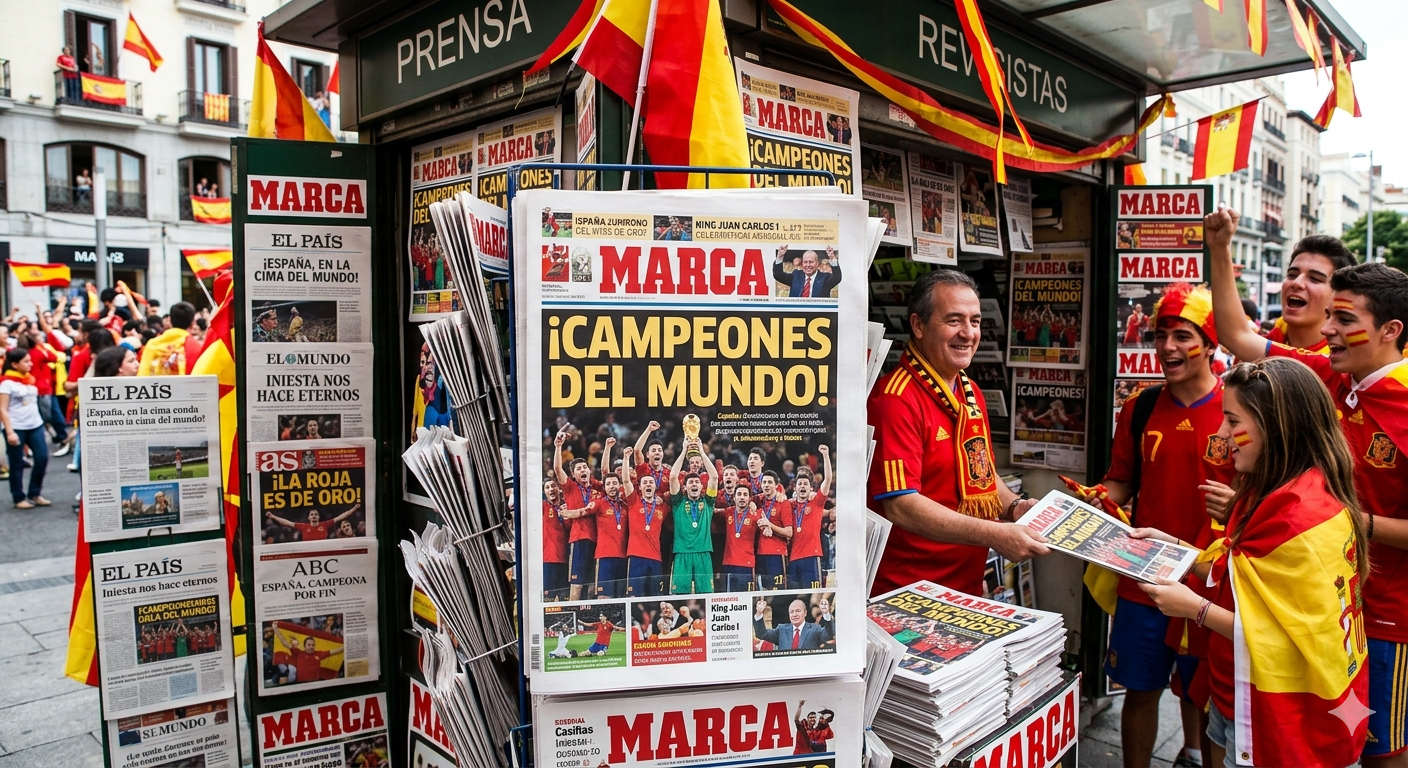
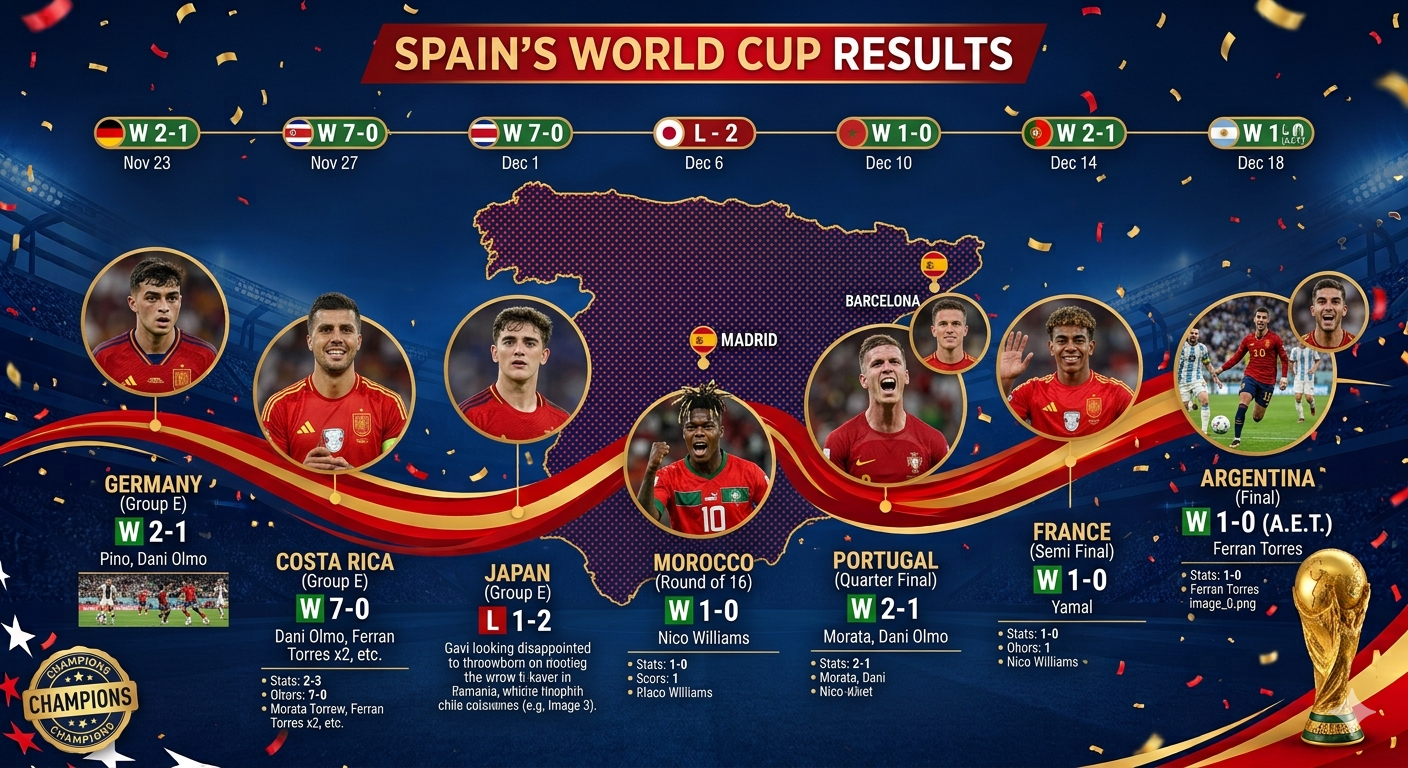
Listen closely and you can hear the heartbeat of an entire country. Sixteen years after Andrés Iniesta's legendary strike at Soccer City in Johannesburg froze time, Spain has done it again. Millions of weeping, cheering fans paralyzed every major city, pouring into the streets to celebrate a staggering 1-0 extra-time victory over Argentina in last Sunday’s World Cup Final.
The initial explosion of unbridled euphoria evolved into a historic, nationwide homecoming celebration.
On Monday afternoon, the chartered flight carrying the Spanish national team touched down at Madrid-Barajas Airport, greeted by water cannons and a sea of red and gold flags lining the tarmac.
Leading the team down the steps was manager Luis de la Fuente, alongside captain Rodri and teenage sensations Lamine Yamal and Pau Cubarsí, triumphantly hoisting the solid gold World Cup trophy to the roaring cheers of airport personnel and early crowds.
Royal Reception: King Felipe VI Welcomes Champions
The team's first official stop was the Zarzuela Palace, where the squad was received for an official state reception led by King Felipe VI. The King, joined by the Royal Family, embraced each player warmly, broke protocol to take a group photo in the palace gardens wearing a custom Spanish jersey, and delivered an emotional address to the team.
"You have not only won the most coveted trophy in sports, but you have also united the heart of an entire nation through your humility, discipline, and flawless teamwork," King Felipe VI announced during the reception.
"This generation has proven that when talent meets sacrifice, no wall is impenetrable. You are an inspiration to every young boy and girl across Spain."
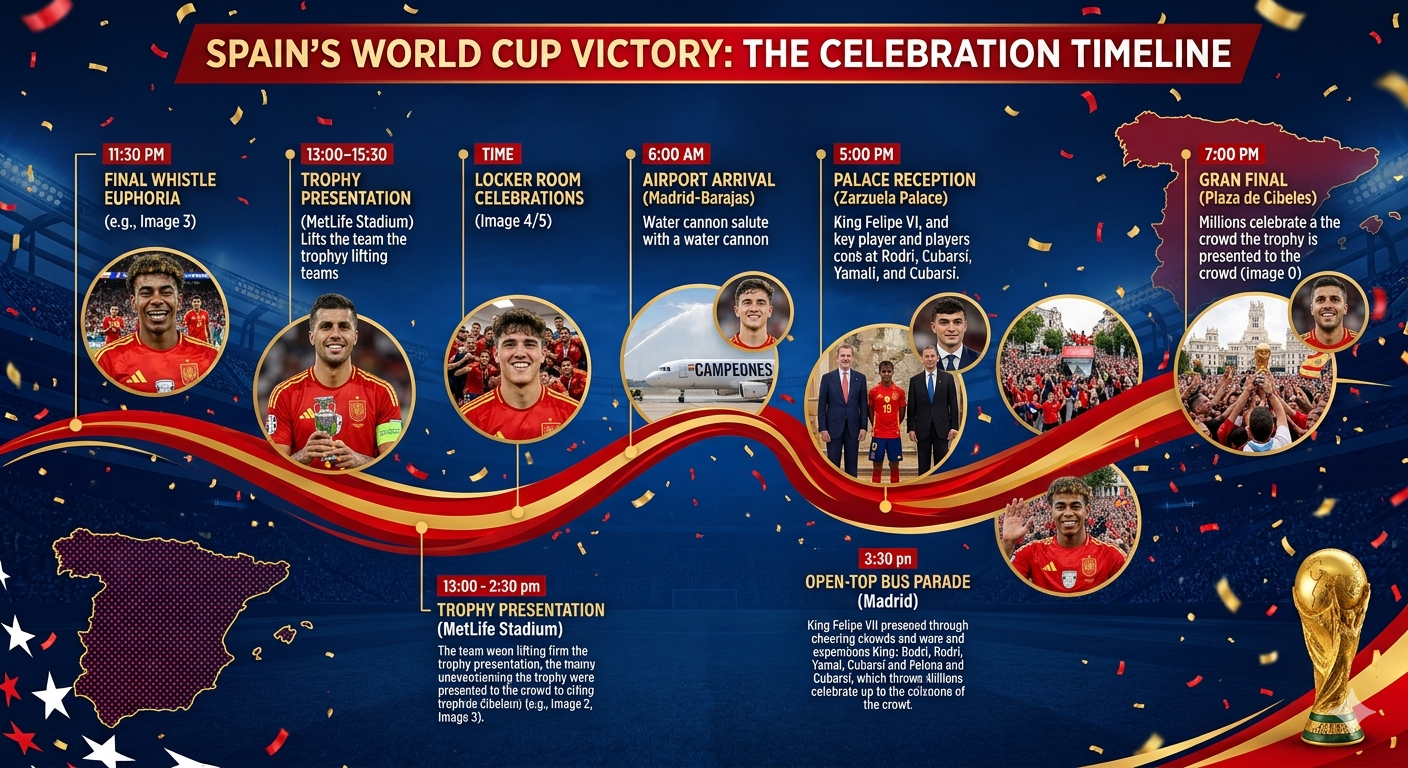
Following the royal reception, the players boarded an open-top victory bus, embarking on a slow, agonizingly beautiful parade through the heart of Madrid. The procession culminated at the Plaza de Cibeles, where over a million fans had gathered since dawn, completely freezing traffic in the capital to catch a glimpse of the history-makers.
Architecture of the Invincible Wall
This monumental title was not forged by individual brilliance alone, but by a flawless, impenetrable system.
"The triumph of the Spanish national team is the triumph of the group over individual talent," journalist Andrés Armero explained to Pura Vida Sports, moments after the final whistle on Sunday night.
Manager Luis de la Fuente built a terrifyingly disciplined defensive machine in his own image, putting his faith in the core group of players with whom he had already won the Euro.
Armero adds: "Never before had Spain possessed such defensive solidity, and they leave the tournament having conceded just a single goal, against Belgium in the quarter-finals."
Tactically, De la Fuente out-orchestrated the world. Rather than relying strictly on individual recovery runs, the Spanish defense operated as a shifting, breathing organism:
The Rodri Anchor: Operating at the base of the midfield, Rodri served as a human shield, completely neutralizing central passing lanes and systematically forcing Argentina's attackers into congested wide areas.
Conservative Fullback Spacing: Fullbacks Marc Cucurella and Pedro Porro were instructed to suppress their natural attacking instincts, prioritizing rigid defensive positioning to deny any over-the-top counter-attacks.
Aggressive Collective Pressing: The moment possession was lost, the frontline triggered a high-intensity, synchronized squeeze to hunt down the ball.
The Veteran Line: Center-backs Aymeric Laporte and Pau Cubarsí maintained an unflinching high line, expertly stepping up to trap attackers or dropping in perfect unison to squeeze out empty space.
Global Verdict: "A Masterclass in Defensive Perfection"
The historic feat of conceding just one solitary goal through an entire World Cup campaign has sent shockwaves through international sports journalism, triggering widespread awe from global media outlets:
The Athletic (UK): "We are witnessing a profound evolution in modern football. De la Fuente has successfully dismantled the myth that high-intensity pressing requires sacrificial defensive vulnerability. Spain did not just win; they suffocated the tournament."
L'Équipe (France): "An iron curtain wrapped in velvet. While Spain's legendary 2010 squad protected itself through endless possession, this 2026 team protects itself through pure, unadulterated structural discipline. Striking against them felt like trying to puncture stone."
La Gazzetta dello Sport (Italy): "The ultimate masterclass in defensive coordination. For a country historically celebrated for its attacking midfield maestros, Spain has ironically put on an absolute clinic in defensive perfection that would make the historic Italian catenaccio masters proud."
ESPN (Global): "To hold a desperate Lionel Messi and a relentless Argentinian attack scoreless over 120 minutes of a high-pressure World Cup final is a legendary accomplishment. This backline has officially earned its place in football immortality."
Immortality of the Teenagers
While the tactical blueprint belonged to the manager, the soul of this tournament was carried on the shoulders of two extraordinary teenagers: Lamine Yamal and Pau Cubarsí.
"It's significant that many of the Spanish players, like Cubarsí or Lamine Yamal, are really young and they managed to compete in the highest stage," David, a prominent Spanish journalist, explained to Pura Vida Sports Africa.
Right winger Lamine Yamal played with the audacity of a kid in a neighborhood park and the maturity of a seasoned veteran. Fresh off his 19th birthday, Yamal terrorized world-class backlines, completing a tournament-high 35 successful take-ons.
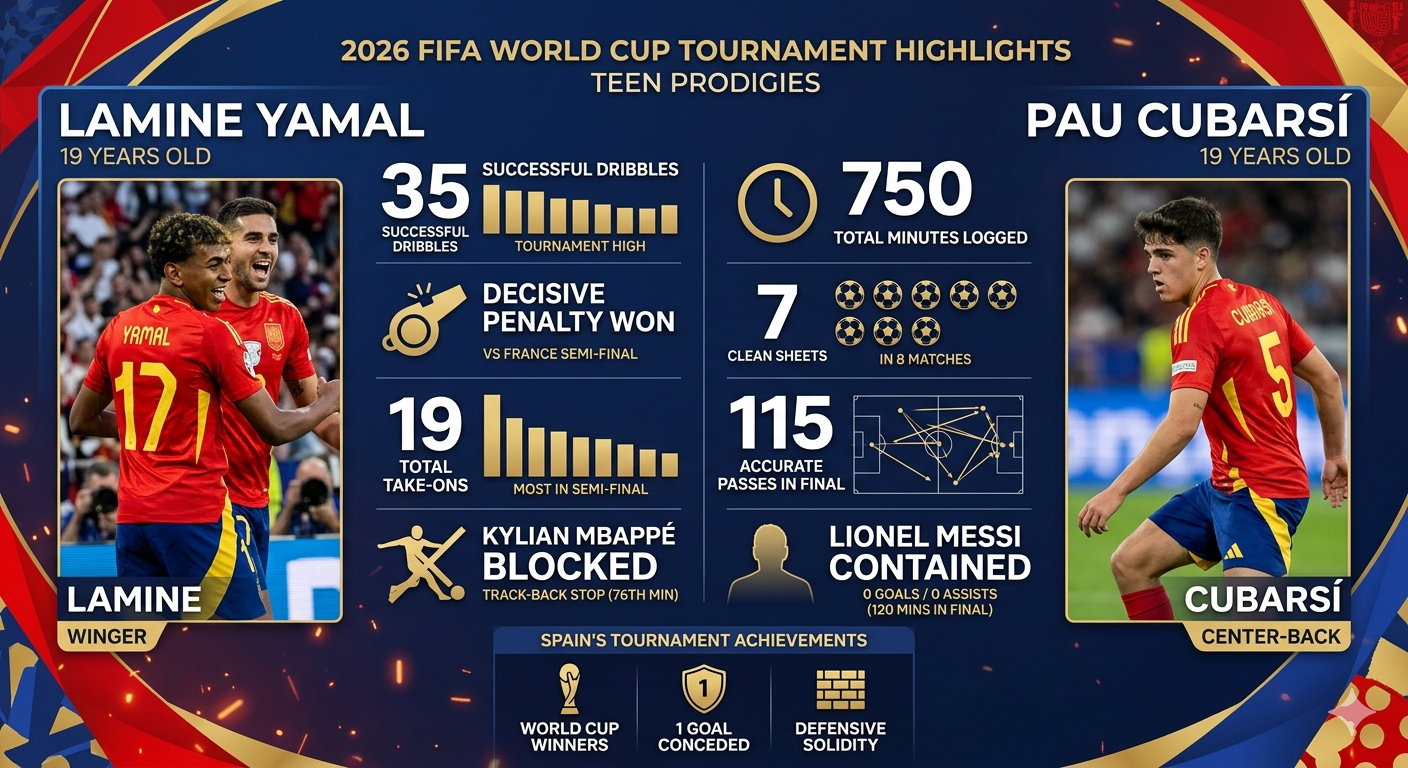
His tournament masterpiece came in the semi-final against France. Not only did his brilliant presence in the box draw the match-winning penalty, but his emotional commitment to De la Fuente's system shone bright when he tracked back 50 yards in the 76th minute to dispossess Kylian Mbappé cleanly.
At the other end of the pitch stood Pau Cubarsí, who played with a cold-blooded tranquility that defied his 19 years of age. Cubarsí logged an unbelievable 750 minutes of tournament football, anchoring a backline that helped goalkeeper Unai Simón achieve a historic seven clean sheets.
In the grueling, bone-rattling final against Argentina, Cubarsí went toe-to-toe with Lionel Messi. For 120 agonizing minutes, Cubarsí stood unblinking, racking up 115 accurate passes and winning crucial tackles to keep the world’s greatest attack completely starved of oxygen.
Deliverance in Extra Time
For the fans, the final was a masterpiece of emotional torture. "During the match Spain has been better than Argentina, however, it has cost a lot and there has been agony, because it seemed that Argentina could tie," Marcos recalls.
David adds blunt context to the tactical battle: "Seriously, Spain won and football also won, because Argentina didn't even try anything. It was a tough final, because Spain has problems to break games when the defense is so close and it's so hard in the tackles."
But history has a beautiful way of repeating itself. "The team, just like in South Africa in 2010, steadily improved as the tournament progressed," notes Armero.
"And the ending was the same: glory in extra time. Sixteen years ago, Andrés Iniesta made history; today, it was Ferran Torres' turn."
Ferran Torres—a warrior who, as David points out, is "a player who has always needed to fight against everything"—rose from the bench to strike a clinical, 106th-minute blow into the heart of the net.
The stadium erupted; an entire nation sobbed. The victory is so sweet because it was born out of doubt. "Without a doubt it's a success, probably unexpected, because this selection, it was known that it could do well, but there was no full confidence that it would be champion," Marcos admits.
"That's why, in Spain, you live perhaps even more happily than the first time, because it was almost unexpected."
Even the youngest generation of fans, who journalists note were previously "too young to grasp the team and club concept" and rooted for Argentina because of Messi, or backed Madrid icons like Mbappé and Vinicius Jr., have been completely conquered by this run.
Madrid-based Evelyne Watta’s ‘Surreal’ Experience
Veteran Madrid-based Kenyan journalist Evelyne Watta was caught in the mix of the euphoria, her son woken up by blaring car horns and whistles as the Spanish capital burst into a frenzy after the final whistle on Sunday night.
“It’s the morning after and it still feels surreal for the Spanish people…. Watching the tournament start, it seemed perennial. Spain always seems to start slow and it can be frustrating for the fans here in Madrid and in Spain, generally, but there was the belief that this is a young team that will get going once they go through the group stages, which they easily did,” Watta reflected on Monday morning.
“When I saw them drawn against France, I said to myself that whoever won that game would be world champions. It was an exciting week since they beat France as there was a sense of belief, but most Spanish people were cautiously optimistic before the final as they were meeting an Argentine team driven by Messi who wanted to retire at the top, and also an Argentine team that was generally more experienced than the Spanish side.
“But once the game started, you could feel the sense of belief even in the Barrios (neighbourhoods), even after the first goal was disallowed… It’s a very good time to be Spanish because even the women are the defending World Cup champions, and the women also won the Euros. It’s a good time as the country prepares to co-host the 2030 World Cup (with Portugal and Morocco) as they will go into the tournament full blast, but the Spaniards are always very modest and very cautious and don’t want to think highly about themselves.
US-Spain Political Tensions Cast Aside by Football
Watta described the celebrations as one huge party that ran into Monday morning, wiping off previous football tears with plans afoot for the World Cup trophy to be paraded in cities across the country over the next few days and weeks.
““There were a lot of red eyes on Monday morning with people waking up after partying late into the night with fireworks and dancing across the city and across the country. This has been a very difficult year for Spanish football because in the Champions League, there was no Spanish team in the final with journalists and football fans saying the country’s game needed a reset. This victory is, therefore, coming at the right time.”
Politically, there was intense tension between US President Donald Trump and Spanish Prime Minister Pedro Sánchez during the World Cup final, the situation fueled by bitter conflicts over military co-operation and NATO defense spending.
Relations soured completely after Spain blocked the US from using Spanish airbases for Iran operations, prompting Trump to threaten trade halts and publicly brand Spain a "terrible partner."
Despite this severe diplomatic hostility and Trump openly cheering for Argentina, both leaders shared an awkward VIP box at MetLife Stadium and temporarily paused their feuds, with Trump shaking Sánchez's hand and helping present the championship trophy to Spain after their 1-0 victory.
And as the victory parade stretched deep into the Madrid night, the message was clear. The wait is over. The team is home. Spain rules the earth once more.
Editor’s Note: Remote digital resources were used in the research and structural planning phases of this article. The final text was entirely written, fact-checked, and edited by human journalists. elias.makori@ymail.com