



By Pura Vida Sports Africa Reporter
Ethiopian Yomif Kejelcha’s breathtaking 56:51 performance at the Buenos Aires Half Marathon did not just shatter the world record by an astonishing 29 seconds—it completely rewrote the tactical playbook for the 21.097-kilometre distance.
By extracting vengeance on Uganda’s Jacob Kiplimo, who had previously lowered Kejelcha’s old 57:30 mark down to 57:20 in Lisbon, the 29-year-old Ethiopian proved that the traditional boundary between track speed and marathon volume has officially dissolved.
To achieve this feat, Kejelcha had to maintain a mind-boggling average pace of two minutes and 41.6 seconds per kilometre. He established his rhythm early, clicking off the opening five kilometres between 2:40 and 2:42 per kilometre, utilizing the flat coastal air of Buenos Aires and his sharp 10,000m track mechanics to break the field.
During the middle stretch from kilometres six to 10, he settled into a metronomic cruise of 2:41 to 2:42 per kilometre, leaning heavily on the deep aerobic reservoir built during his recent marathon training.
Extraordinary Long-range Kick
As the race entered the critical territory from kilometres 11 to 15—the exact threshold where Kiplimo’s previous world-record pace typically breaks opponents—Kejelcha absorbed the mounting fatigue. He refused to let his pace slip past 2:43 per kilometre, relying on his historical strength as the world indoor mile record holder to keep his stride fluid.
Sensing the historic sub-57-minute barrier was within reach, Kejelcha unleashed an extraordinary long-range kick over the final five kilometres. He dropped his pace to a blistering 2:39, then 2:38, before a final kilometre explosion of 2:35 brought him home to a roaring Argentinian crowd.
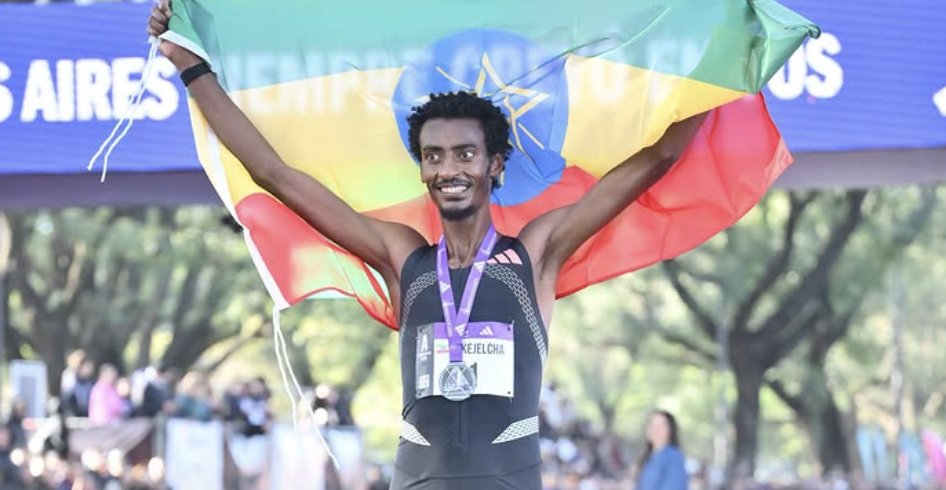
Yomif Kejelcha’s phenomenal 56:51 victory in Buenos Aires was accelerated by cutting-edge carbon-plated shoe technology and backed by massive global financial incentives. (Photo / Courtesy)
This historic run highlights a fascinating clash of training philosophies between two of the greatest distance runners on earth. Kiplimo is a pure road-and-cross-country engine who builds his supreme cardiovascular efficiency on a steady diet of 160 to 170 kilometres a week over the punishing, undulating hills of high-altitude Kapchorwa.
Kejelcha, by contrast, has engineered a high-volume hybrid programme. He peaks at an intense 180 to 190 kilometres a week, combining specialized 10km road speed sessions with grueling 35 km long runs.
By pairing his raw track speed with the extreme metabolic efficiency that allowed him to run a stunning 1:59:41 marathon debut in London, Kejelcha made a 2:41 kilometre pace feel comfortably sub-maximal, cementing his legacy as a pioneer of modern distance running.
The Projected Kilometre Splits: Sustaining the Unthinkable:
To cross the finish line in 56:51, Kejelcha had to maintain an average pace of 2 minutes and 41.6 seconds per kilometre.
While official, localized sector data from Buenos Aires emphasizes his metronomic consistency, a mechanical breakdown of his pacing structure reveals how he structurally dismantled Kiplimo's old mark:
Kilometres 1–5 (The Launch): 2:40, 2:42, 2:41, 2:41, 2:42:
Kejelcha utilized the flat, fast coastal air of Buenos Aires to establish immediate rhythm. Tapping into his 10,000m track mechanics, he came out slightly ahead of world-record pace to break the field early.
Kilometres 6–10 (The Cruising Altitude): 2:42, 2:41, 2:41, 2:42, 2:41:
Entering the mid-race stretch, Kejelcha leaned heavily on his recent marathon endurance block. His stride remained fluid, maintaining an unwavering cadence that deflated any trailing competitors.
Kilometres 11–15 (The Kiplimo Threshold): 2:42, 2:42, 2:41, 2:43, 2:41:
This is where Kiplimo’s 57:20 pace usually breaks opponents. Kejelcha, however, absorbed the cumulative fatigue by relying on his historical strength as a world indoor mile record holder, keeping his splits strictly under 2:43.
Kilometres 16–21.1 (The Kick): 2:41, 2:40, 2:41, 2:39, 2:38, 2:35 (Final 97 metres sprint):
Smelling the historic sub-57 barrier, Kejelcha unleashed an extraordinary long-range kick. He closed the final kilometres at a pace resembling an elite track 5,000m finish.
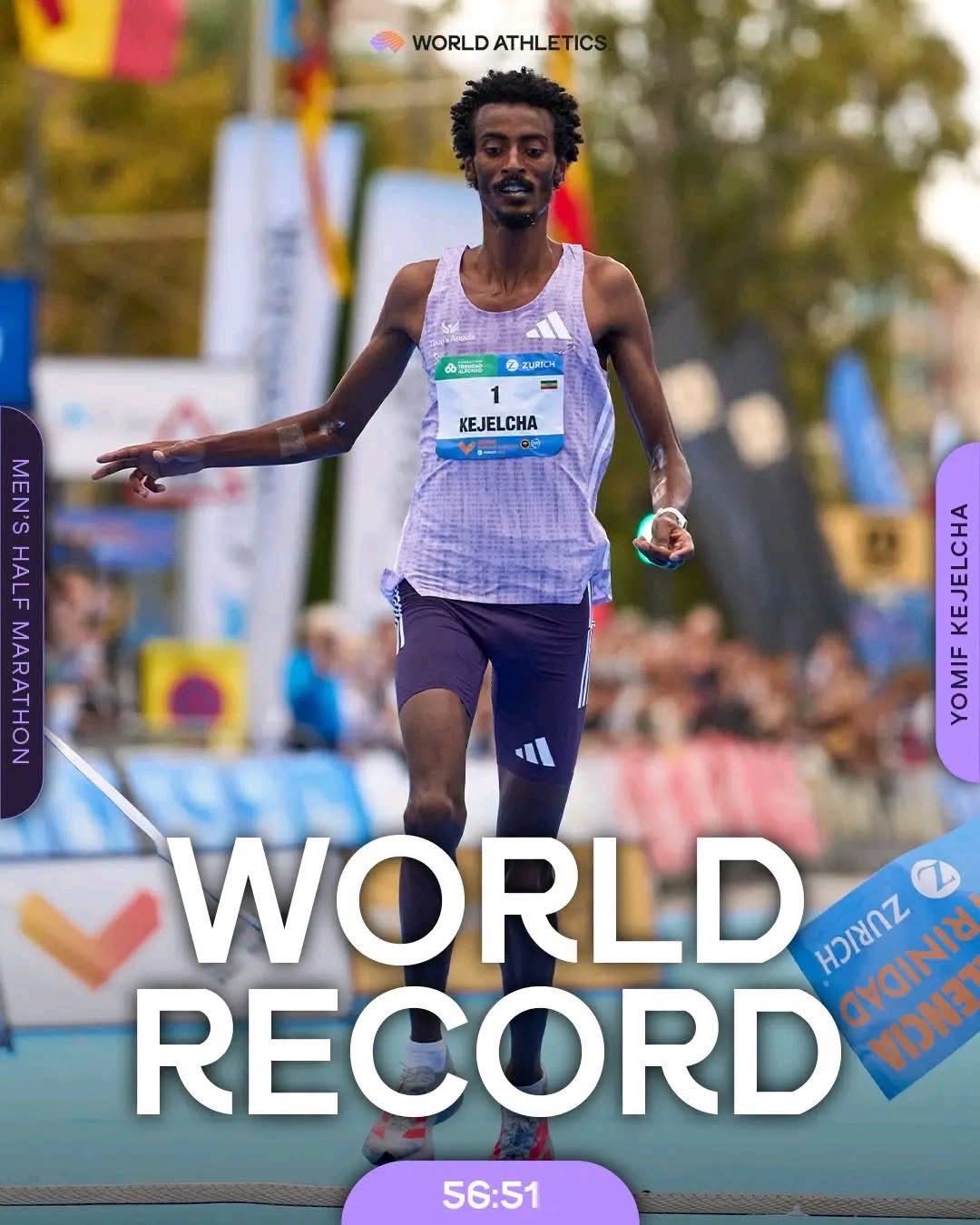
World Athletics' tribute to Kejelcha's half marathon world record.
Training Philosophies: How Kejelcha Out-Engineered Kiplimo
The battle for the global half-marathon crown is a war between two distinct physiological profiles. Kiplimo is a pure road-and-cross-country engine, while Kejelcha is a track fundamentalist turned volume hybrid.
Kiplimo's training focuses on punishing, sustained tempo runs on the undulating terrain of Uganda, allowing him to hold a grueling pace regardless of wind or elevation changes.
Kejelcha, conversely, unlocked his 56:51 record by merging his lethal track pedigree with the extreme metabolic efficiency required to run a 1:59:41 marathon debut in London.
His training block featured intense 10 km road speed sessions (leveraging his 26:31 world record capacity) immediately followed by 35 km long runs. This rare combination meant that a 2:41 pace per kilometre felt comfortably sub-maximal, enabling him to obliterate the global standard.
How they compare:
Yomif Kejelcha (Ethiopia):
Core Engine: Track speed background, holding the Indoor Mile World Record and a 10,000m World Championship Silver medal;
Weekly Mileage: Peaks at 180–190km, heavily boosted by his recent marathon training transition;
The X-Factor: Sub-2-hour marathon endurance, proved by his blazing 1:59:41 debut performance in London;
Pacing Strategy: Aggressive, front-running metronome who sets an unrelenting pace from the gun.
Jacob Kiplimo (Uganda):
Core Engine: Pure cross-country and road background, optimized for sustained grinding efforts;
Weekly Mileage: Maintains a steady 160–170km block in the high-altitude terrain of Kapchorwa;
The X-Factor: Unmatched raw cardiovascular efficiency when attacking grueling hills and undulating roads;
Pacing Strategy: Tactical hunter who sits in the pack before unleashing a devastating kick in the final 2 km.
Record-breaking Footwear, Huge Pay Day
Yomif Kejelcha’s phenomenal 56:51 victory was accelerated by cutting-edge carbon-plated shoe technology and backed by massive global financial incentives.
The Ethiopian superstar shattered the world record while wearing the ultra-lightweight Adidas Adizero Adios Pro Evo 3, which weighs just 138 grammes and stands as the lightest racing shoe on the market. Instead of traditional internal energy rods, this model features a specialized carbon rim wrapped around the exterior of the midsole, offering explosive energy return and a proven 1.6% increase in running economy.

Ethiopian podium sweep in Argentina: Yomif Kejelcha (centre, 56:51 - New World Record), Tadese Worku Gebresilase (left, 59:20) and Bereket Nega Batebo (1:00:20) dominated the Buenos Aires podium. (Photo / Pool)
Having previously powered Kejelcha to his historic 1:59:41 sub-two-hour marathon debut in London, this footwear innovation made the blistering 2:41 per kilometre pace feel remarkably manageable through the streets of Buenos Aires.
By becoming the first human to officially run a half marathon under the elusive 57-minute barrier, Kejelcha also triggered a massive financial windfall.
Elite World Athletics Label road races structurally award base winners' purses alongside tiered world record incentives, with major event bonuses typically scaling between $50,000 and $125,000 for historic times.
More significantly, breaking such an elite structural milestone triggers highly lucrative, private performance clauses embedded within brand sponsorship contracts. Between official governing body prizes and commercial milestone payouts, Kejelcha's historic morning in Argentina is set to earn him hundreds of thousands of dollars. (Analysis from multiple digital resources)