



For decades, the Melbourne Cricket Ground (MCG) has stood as a hallowed amphitheatre of human excellence, a stage where cultural, spiritual, and sporting deities have etched their names into legend.
Its turf has vibrated to the historic, record-shattering notes of modern pop royalty like Ed Sheeran and Taylor Swift, and absorbed the mythic presence of 20th-century icons like Michael Jackson, Madonna, and David Bowie.
It is a place of profound cultural milestones, where His Holiness Pope John Paul II drew over 60,000 faithful in 1986, transforming the stadium into a sanctuary of global reverence. The Pope visited the MCG twice during his brief, 36-hour stay, marking two completely distinct, massive cultural gatherings at the stadium: An Ecumenical Celebration and meeting with the Polish Community.
As the spiritual colosseum of Australian sport, it is the fortress where cricket legend Sir Donald Bradman established his immortal 128.53 batting average, where spin bowler Shane Warne spun his 700th Test miracle, and where a roaring crowd of 121,696 witnessed the greatest Aussie Rules Football comeback in history.
Melbourne is a city and a stadium built for the monumental - from the high-octane chaos of Max Verstappen’s Formula 1 triumphs at Albert Park to the pioneering athletic footprints of Betty Cuthbert during the 1956 Olympic Games.
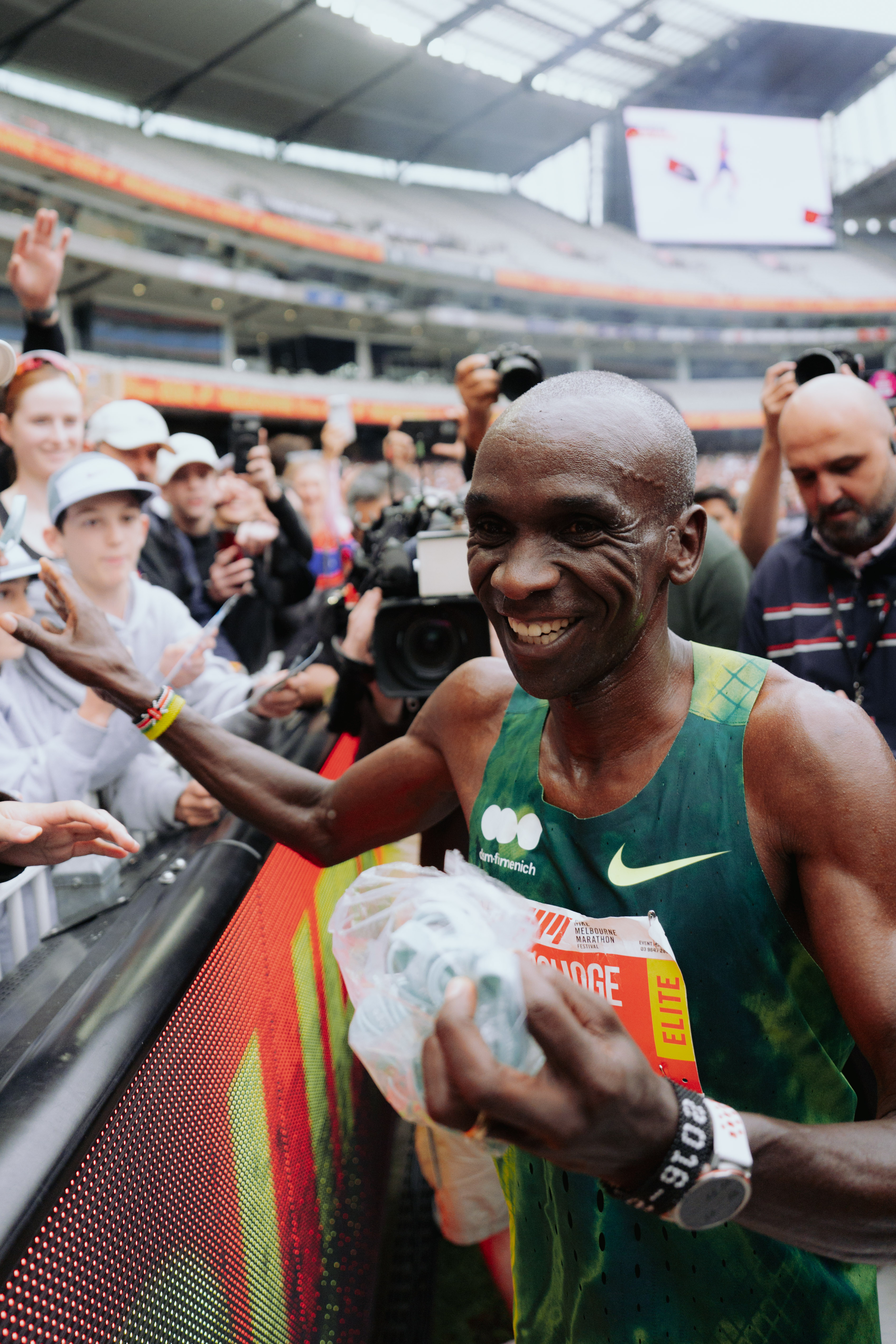
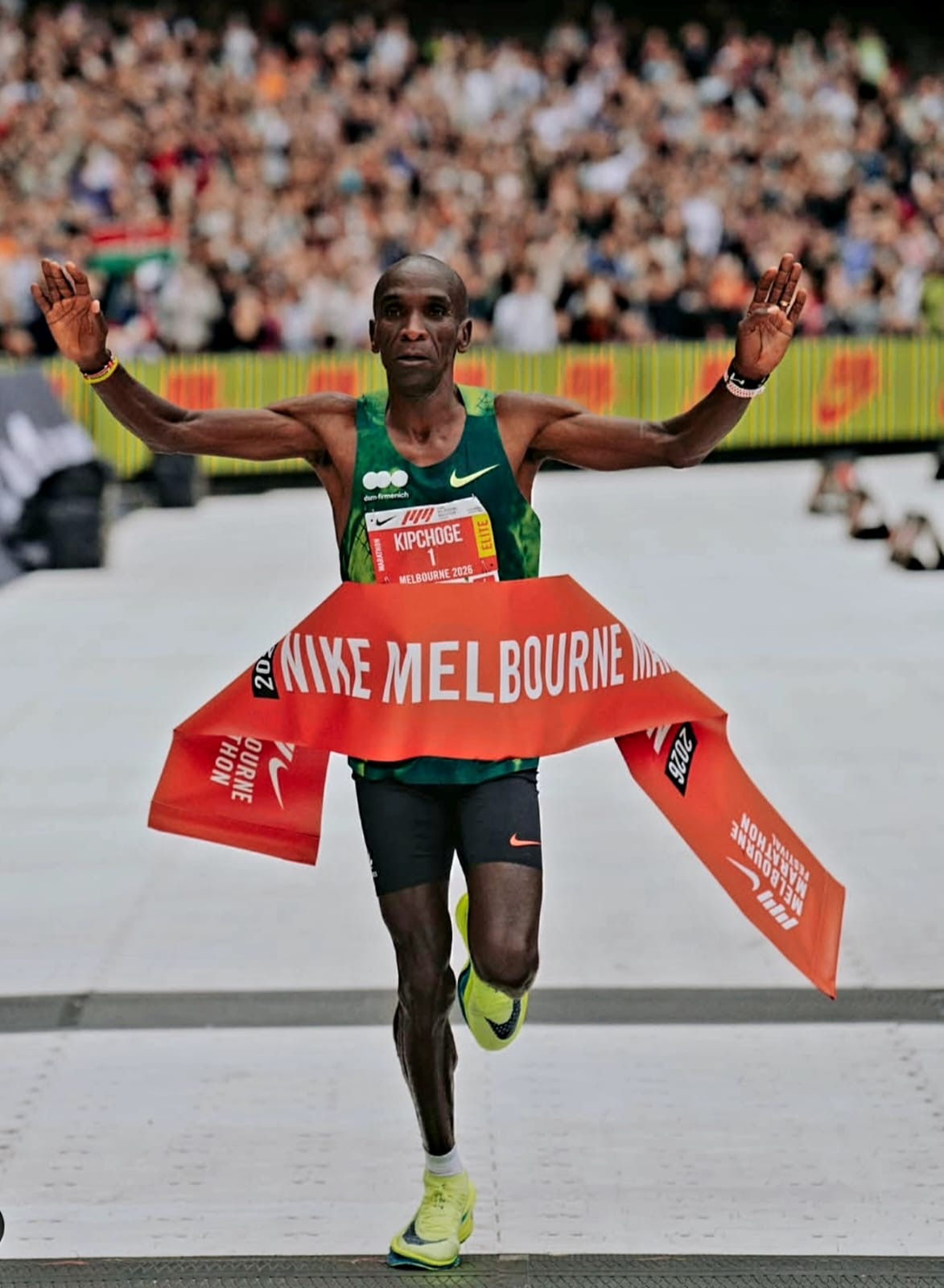
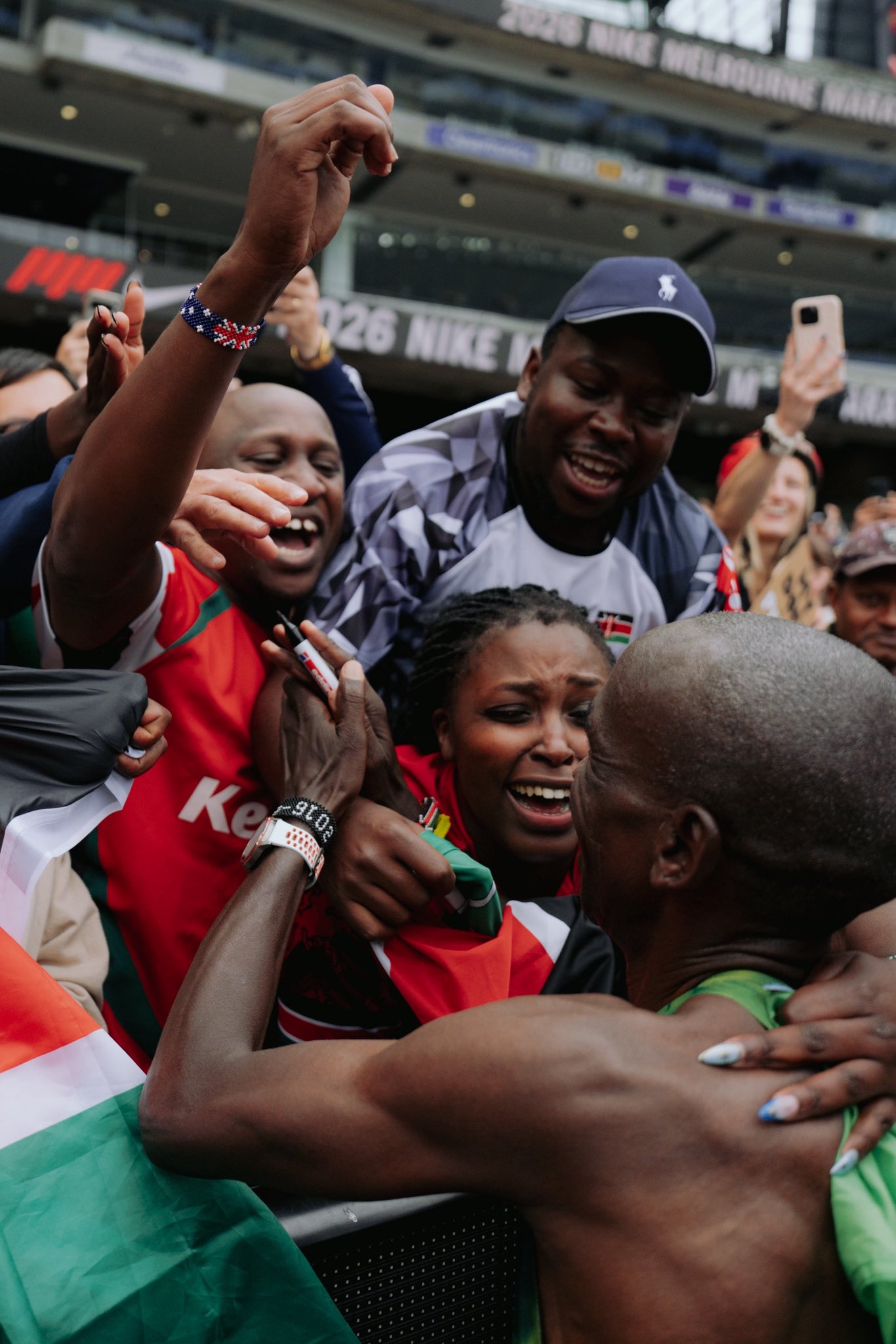
When Eliud Kipchoge crossed the finish line to capture his Melbourne Marathon victory right on the sacred MCG turf - celebrating in the arms of, among others, compatriot and training mate Augustine Choge, who, 20 years ago at 19, upset homeboy Craig Mottram to win the 2006 Melbourne Commonwealth Games 5,000m at the very MCG arena - a new kind of history was written.
Entering a city accustomed to the blistering speed of F1 supercars, the thunderous applause of nearly 110,000 concertgoers, and the mass devotion of a Papal visit, the greatest marathoner of all time brought a quiet, transcendent majesty to the MCG.
By conquering Melbourne's streets and finishing inside this legendary arena, Kipchoge didn't just win a race; he joined the pantheon of global icons who have redefined the boundaries of what is possible on this sacred ground.
The 41-year-old dsm-firmenich Running Team athlete put on a masterclass in precision pacing, locking into a metronomic rhythm from the very first stride. Moving across the flat Melbourne course at an average pace of 3:03 per kilometre, Kipchoge clocked a blazing 15:19 at the 5km mark and crossed the 10km checkpoint in 30:40. He maintained his effortless stride through the 15km mark at 45:53, reaching the halfway banner in a controlled 1:04:19 with a debutant rival breathing down his neck.
As the race moved deep into the second half, the dual-combat continued through 25km in 1:16:04 and 30km in 1:31:09. It was right here, as the grueling distance began to wear down the rest of the field, that the master strategist chose to strike.
Kipchoge shifted gears effortlessly, triggering a devastating late-race acceleration that saw him break away completely over the final 10 kilometres. Passing the 35km mark in 1:46:37 and the 40K banner in 2:02:14, he turned the final stretch into a victory lap.
Australian Thomas Do Canto was the first to crack, dropping off the pace around 22km and the race developed into a two-way battle between the Kenyan and home athlete James Whelan. Maintaining a relentless tempo, Kipchoge made his winning move a little before 27km. Quickly opening up a gap on Whelen he enjoyed the final 15km of the race running in splendid isolation.
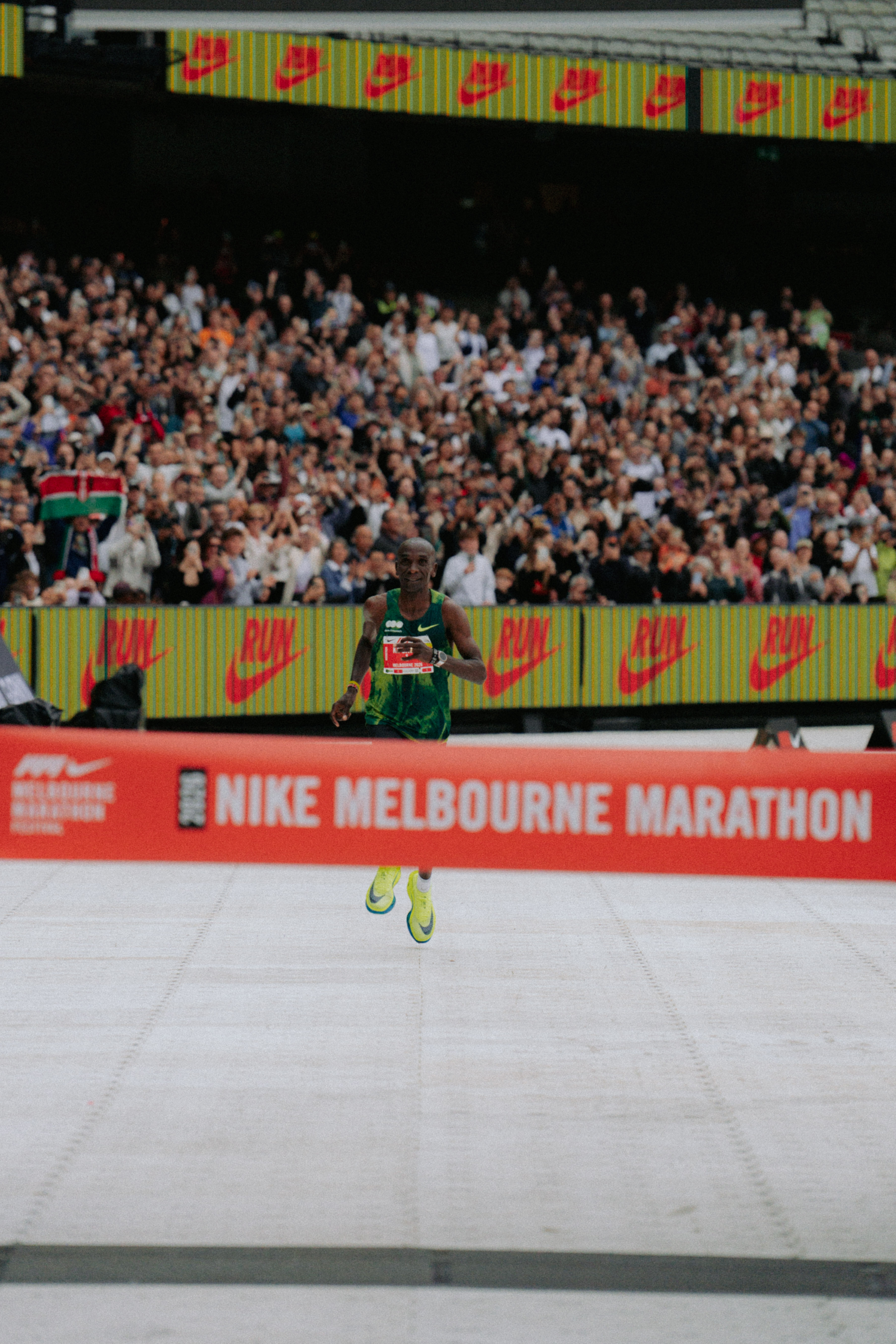
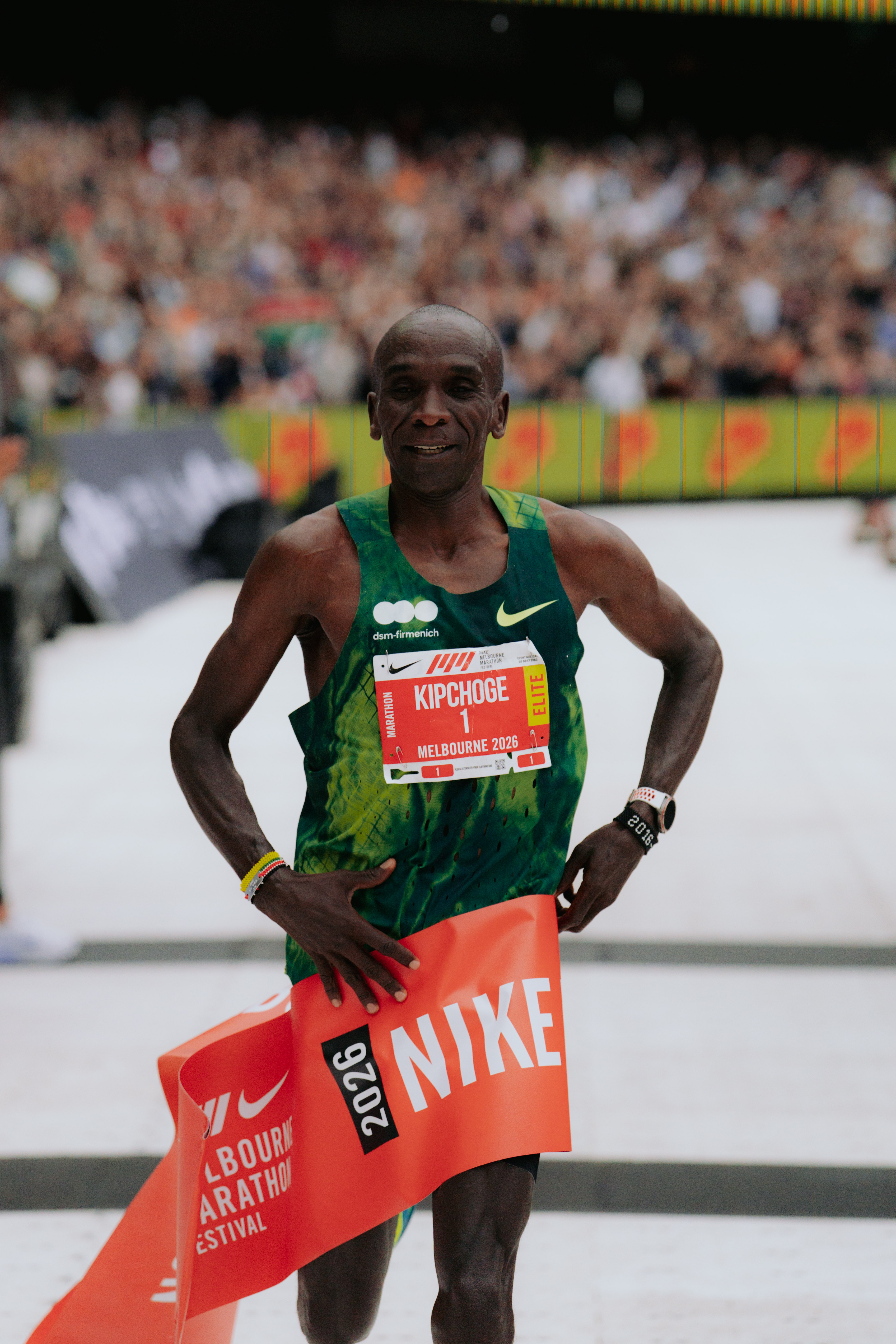
Roared on by the enthusiastic supporters, the Kenyan great crossed the finish line to claim another historic victory inside the iconic Melbourne Cricket Ground (MCG), host of the 1956 Olympic Games.
It was the 17th marathon victory in the Kenyan legend’s incomparable career.
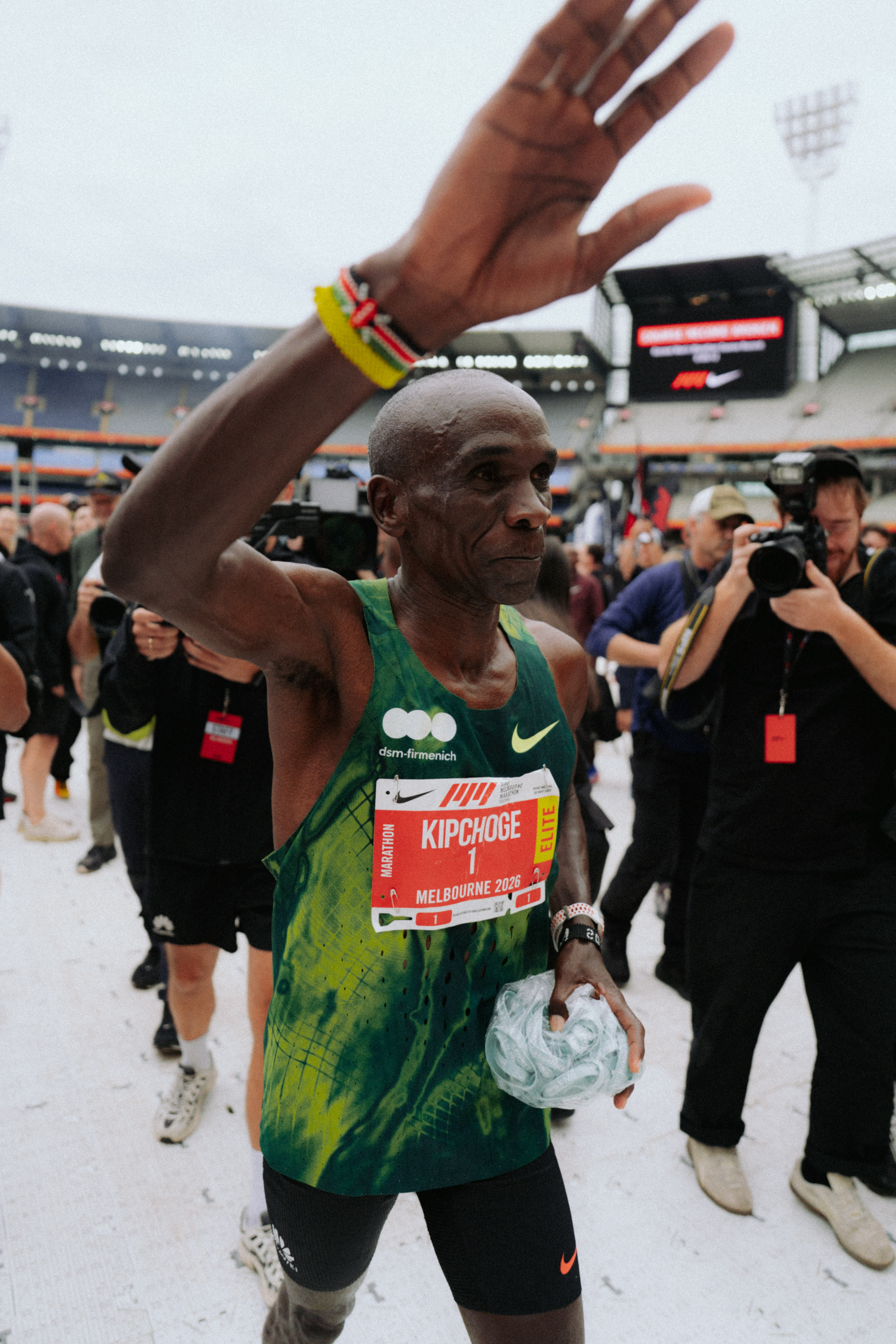
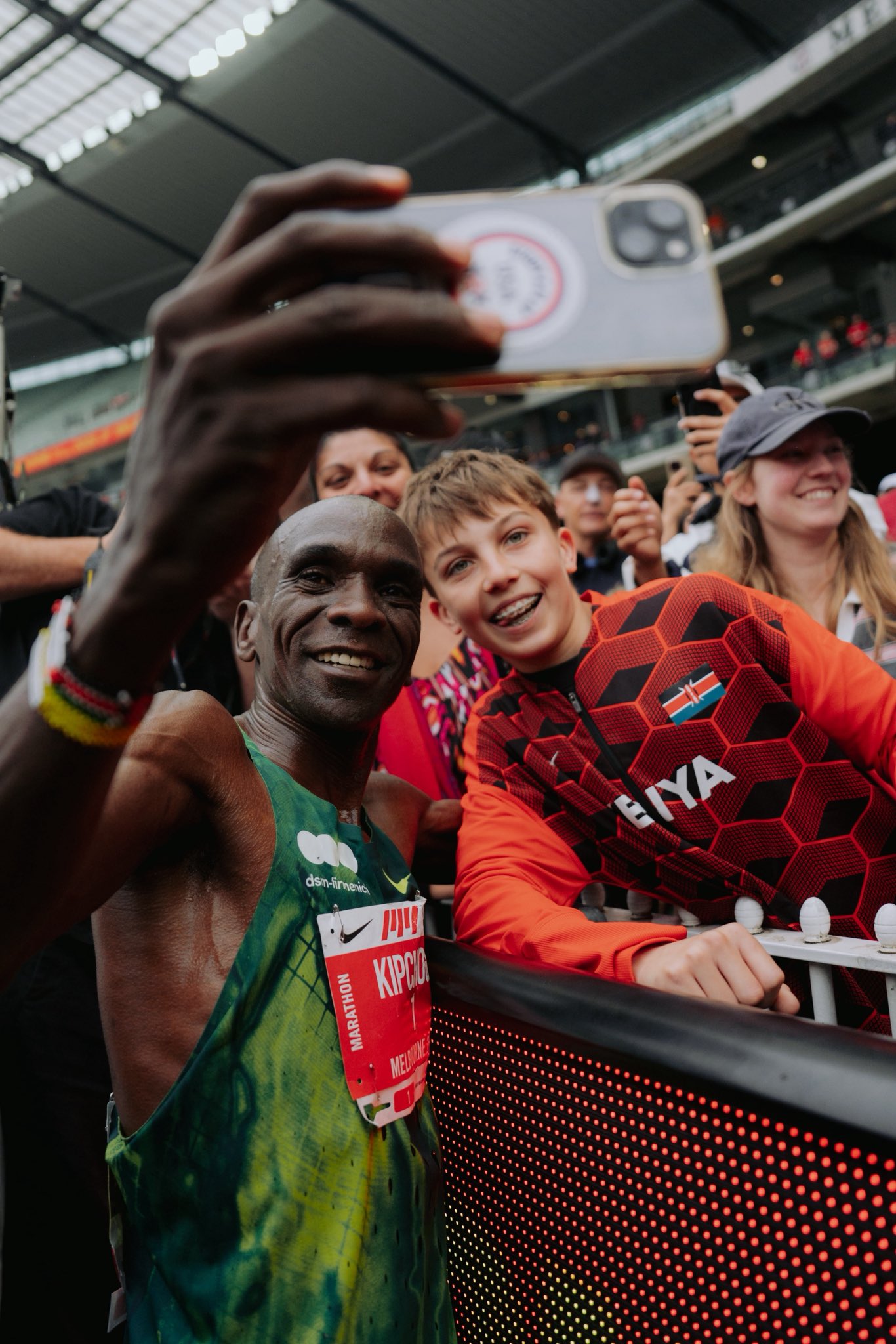
Stepping onto the hallowed turf of the MCG, Kipchoge still found the energy to wave and interact with thousands of roaring fans lining the stadium fences.
He crossed the finish line in a final winning time of 2:09:10, shaving two seconds off the previous course record and safely holding off Do Canto.
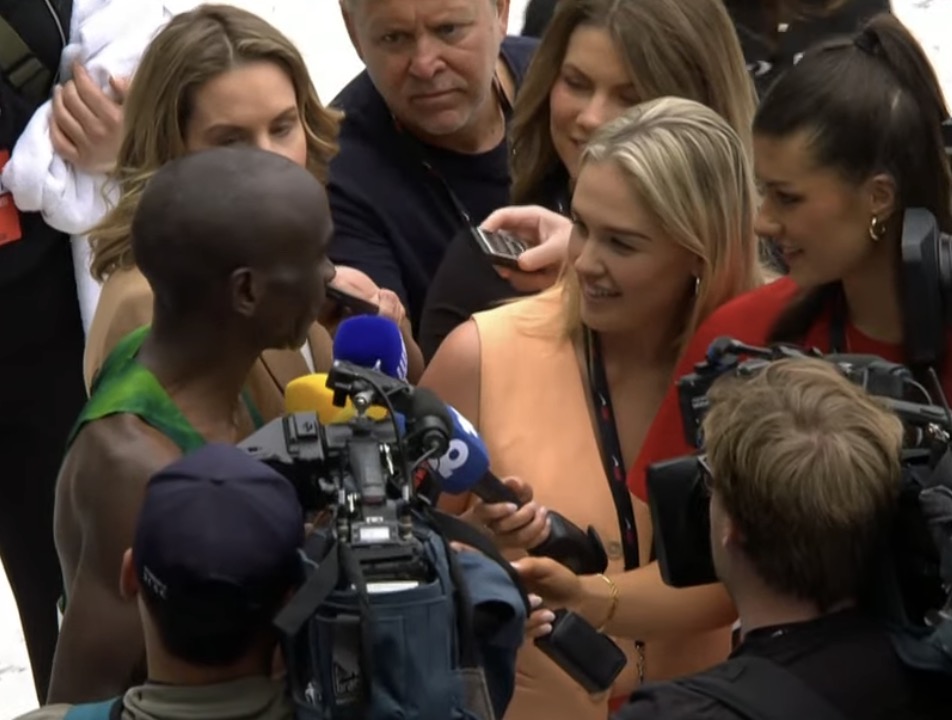
The G.O.A.T. was very much aware of the Melbourne legend, and sought to honour the city’s extraordinary sporting cocktail: “The race was great, the crowd was wonderful, it was awesome… I said yesterday that I was encouraging the people living in Melbourne to come out in large numbers and actually on the course, it was really wonderful and I enjoyed seeing people standing, cheering and shouting my name… the course was wonderful all round,” the legend reached.
Kipchoge acknowledged the sporting pedigree of Melbourne, famous for its cricket heritage alongside Formula One contests. “This was different… running in a beautiful course touching a Formula One track and finishing on a cricket ground. It’s really wonderful to have three sports in one… you can imagine running on a Formula One track and finishing on a cricket ground – it was more than a sport.”
The two-time Olympic marathon champion and former world record holder said he loved his four days in Melbourne so far, adding that he had “given back to the Melbourne people by running a course record” which he noted was a message to the younger generation athletes to push themselves.
“It’s about pushing yourself, that’s what sport is all about,” he noted. “It makes me proud to run with the younger generation and inspire the running community in Melbourne. Today was about more than sport. It was about the energy of the city, the huge support along the race route, running alongside so many other runners, and a stunning finish at the MCG. No words can describe that feeling. Thank you, Melbourne.”
The legend added that he was delighted to travel to Melbourne with his wife Grace who was also pounding the Melbourne course. “It’s good for the family to come together, feel the experience and celebrate together.”
Kipchoge’s historic triumph marks a monumental milestone for Oceania, serving as the third successful leg of Kipchoge’s ambitious global campaign to conquer a marathon on all seven continents.
Having already opened the tour on African soil at the Cape Town Marathon and swept through South America via the Porto Alegre Marathon in Brazil, the legendary distance runner has now securely checked off three of the world’s geographical zones.
The next phase of his global odyssey pivots toward the remaining frontiers of Europe, North America, and Asia, where he will continue to bring elite racing directly to global running communities. Each stop doubles as a fundraising and awareness platform to raise $1 million for the Eliud Kipchoge Foundation, promoting global literacy, education, and environmental sustainability.
The entire historic project is slated to culminate in the most logistically daunting challenge of his storied career: an unprecedented, final elite-level marathon across the frozen plains of Antarctica.
Eliud Kipchoge’s Global Tour so far:
- Africa (Cape Town, South Africa) - 16th - 2:13:29;
- South America (Porto Alegre, Brazil) - 12th - 2:18:42;
- Oceania (Melbourne, Australia) - Winner - 2:09:10;
Leading results from the 2026 Melbourne Marathon:
Men:
- Eliud Kipchoge (Kenya) 2:09:10
- Thomas De Canto (Australia) 2:10:35
- Reece Edwards (Australia) 2:14:33
- Bailey Murzecki-Hince (Australia) 2:15:06
- James Whelan (Australia) 2:17:03
- Steven McKenna (Australia) 2:17:55
- Tom Bowers (Australia) 2:18:00
- Benjamin Beischer (Australia) 2:18:24
Women:
- Camille French (New Zealand) 2:28:25
- Sinead Diver (Australia) 2:28:49
- Caitlin Adams (Australia) 2:30:26
- Sarah Klein (Australia) 2:35:59
- Milly Clark (Australia) 2:37:39
- Greer Wilson (Ireland) 2:37:56
(With additional reporting by dsm-firmenich Running Team; Photos: dsm-firmenich Running Team)